Drawing for Preschoolers: A Parent’s Guide
Somewhere between the third birthday and kindergarten, most kids discover that a crayon is basically a magic wand. What comes out is wobbly and wonderful: a dog with eight legs, a house with a door on the roof, a self-portrait that is, technically, three circles and a wish.
And then, usually, one of two things happens. Either the kid keeps drawing with total confidence for years — or somebody (another kid, an older sibling, a well-meaning adult) laughs at the eight-legged dog, and the crayon goes quiet. This guide is about keeping the magic wand in the hand. If your child is between three and five, here’s everything we’d tell you if we could sit at your kitchen table.
First, the Supplies (Keep It Simple)
You don’t need much. In fact, too many supplies is a classic beginner-parent mistake — a 64-pack of crayons is a clutter explosion waiting to happen, not a starter kit.
- Chunky crayons or washable markers. Chubby crayons fit small hands and don’t require much pressure. Washable markers are the parent-sanity option. Pick one or the other for now.
- Plain paper, lots of it. Printer paper is fine. Sketchbooks feel special — kids treat them like treasure chests, which is exactly the attitude you want. Avoid tiny notebooks; preschool hands need room.
- That’s it. No pencil sharpeners, no 12-shade pencil sets, no erasers. Erasers teach kids that mistakes need undoing, and at this age, “mistakes” are where the fun lives.
One more supply worth mentioning: tape. You’ll want to tape today’s best drawing to the wall immediately. Fridge, hallway, bedroom door — anywhere it gets seen. A three-year-old who sees their art displayed will draw twice as much tomorrow. We didn’t make that statistic up, but we’d believe it.
The Right First Drawings
Preschoolers need drawings they can finish before their attention wanders — which means about three to five simple shapes, start to finish. We’ve watched a lot of little kids work through our tutorials, and these seven are the ones that reliably end in a finished drawing instead of a crumpled page:
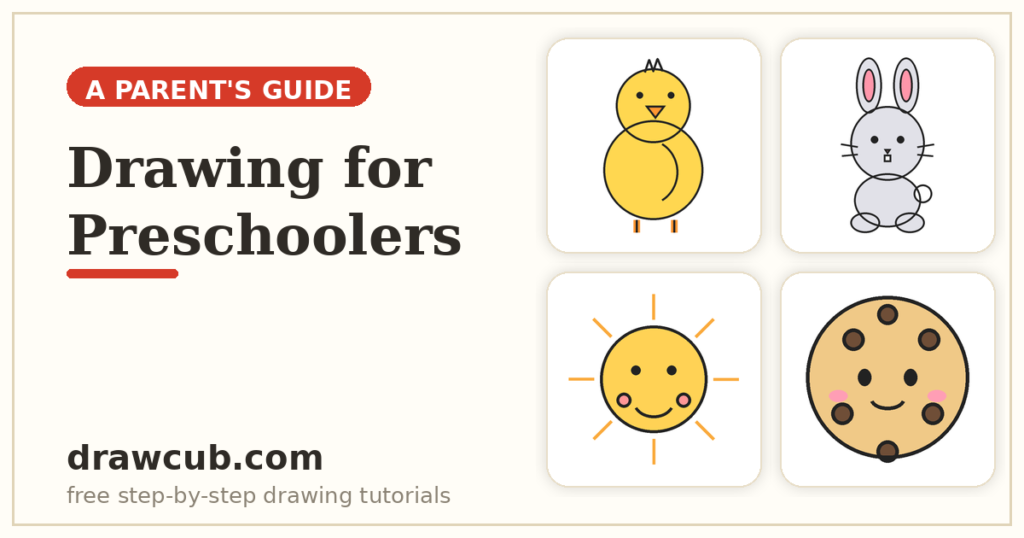
Round body, round head, triangle beak. Three shapes, and the whole thing reads as “baby bird” to anyone with eyes. The chick is our number one recommendation for a first-ever drawing, because it’s genuinely hard to get wrong. A lopsided chick is still a chick — it’s just a chick with personality.
Every childhood sketchbook starts here: a circle with rays. But our version adds a little more character, and it’s the perfect lesson in one of drawing’s great truths — you can draw the same circle every single day and it will make you happy every single time. The sun also becomes the finishing touch on every future drawing.
Circle center, petal loop-de-loops around it. The daisy is secretly a fine-motor-skills workout disguised as a flower — those petals ask little hands to do controlled curves, which is exactly the practice that helps with writing later. The kids don’t know that. They just think they drew a flower, and they beam.
Fish are the cheat code of preschool drawing. An oval, a triangle tail, one dot for an eye — done. The fish swims along in about two minutes flat, which means it’s perfect for the kid whose attention span is currently measured in seconds. Draw three fish and you’ve got an aquarium. Draw ten and you’ve got wallpaper.
Circle, chocolate chips, done. The cookie might be the most relatable drawing in this entire list — every preschooler has strong feelings about cookies. Let them pick the chip placement. (We recommend not eating the drawing, though at this age, supervision may be required.)
The bunny is the step up. Two long ears, a round face, whiskers — it’s maybe six shapes, and the ears teach a satisfying lesson about symmetry without anyone saying the word “symmetry.” Ears that don’t match just make the bunny look jaunty. Nobody has ever drawn a bad bunny.
Our graduation piece. The cat adds a tail, ears, and whiskers to everything the bunny taught, and when a preschooler finishes their first recognizable cat, something clicks. You’ve seen that look if you’ve seen it — the look of a kid who just realized they can draw anything. After the cat, they’re ready for whatever comes next.
How to Sit With Them (This Matters More Than the Tutorials)
Here’s the part most guides skip: your job isn’t to teach. It’s to be the audience. The co-artist. The person who gasps at the right moment. A few things we’ve learned from watching parents do this well:
- Draw your own, badly, on purpose. Sit next to them and follow the same tutorial. Your cat will look worse than theirs. This is the best possible outcome — it shows them that drawing is about trying, not being perfect. If you’re actually good at drawing, this is your one chance to sandbag. Enjoy it.
- Praise the specific thing. “Nice drawing” is fine, but “I love how you made the sun’s rays all different lengths” is a thousand times better. Specific praise teaches them what they did right, so they can do it again.
- Never “fix” their drawing. This is the big one. Don’t take the crayon and show them the “right” way to draw the ear. Their ear is the right ear. If they ask for help, help. If they don’t, admire.
- Ask questions, not corrections. “Tell me about your dog!” gets you a story. “That doesn’t look like a dog” gets you silence. At this age, every drawing has a story, and the story is half the point.
- Five minutes counts. You don’t need a thirty-minute art session. One tutorial, one drawing, five minutes — that’s a complete win. Daily five-minute streaks beat occasional hour-long marathons.
A Few Things to Skip
- Coloring books with tiny details. Those intricate mandala-style coloring pages are for older kids (and stressed adults). Preschoolers need big shapes and permission to scribble outside the lines. They will scribble outside the lines. That’s the curriculum.
- Comparison with siblings. “Your sister drew a better cat” is how you end a drawing habit. Compare each kid only to their own drawings from last month.
- Rushing to realism. Somewhere around four, kids start asking “does it look real?” The honest answer is: it doesn’t need to. The eight-legged dog is a better dog than a boring one.
Why This Is Worth Your Five Minutes a Day
Drawing does more for a preschooler than almost any other five-minute activity — it builds hand strength for writing, teaches them to plan and finish something, and gives them a way to think out loud on paper. If you want the full picture, our guide on the benefits of drawing for kids goes through what actually happens in their developing brains while they’re sketching circles. Spoiler: it’s a lot.
Your Turn (Yours, the Parent)
Tonight, tape two sheets of paper to the kitchen table, hand your kid the chunky crayons, and draw a chick alongside them. Five minutes. Then hang both drawings on the fridge — yours and theirs, side by side. And when you’re ready for tomorrow’s drawing, grab our free Starter Pack for printable practice pages made for little hands.