12 Easy Flower & Nature Drawing Tutorials for Kids & Beginners (Step by Step)
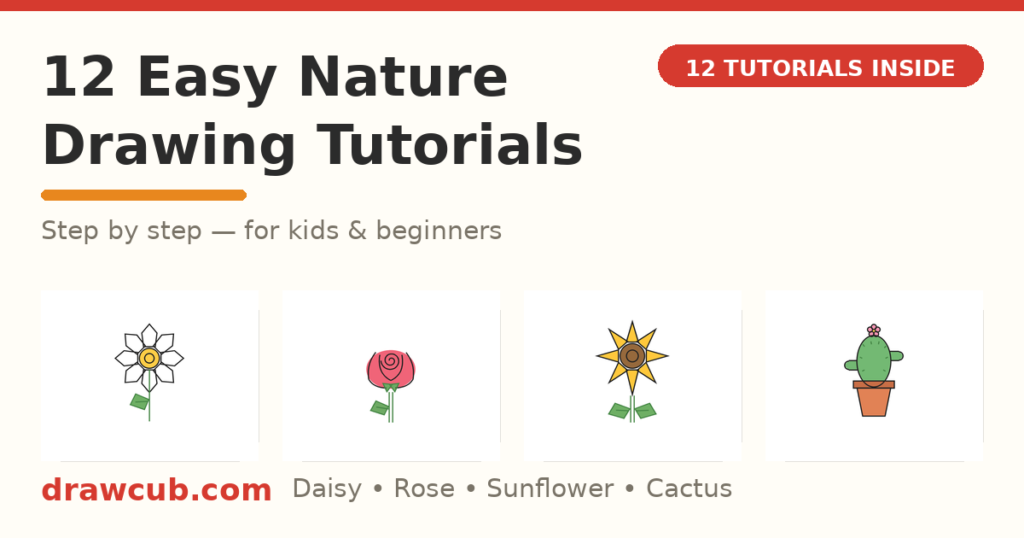
Here’s the thing about nature drawings: they’re the best-kept secret for beginners. Flowers and trees don’t judge you. A petal drawn slightly crooked? That’s character. A tree that’s a bit lopsided? Real trees lean, too.
That’s why this list is our most recommended starting point for anyone who’s never picked up a pencil before. Every tutorial below follows the DrawCub way — one red line at a time, five minutes per drawing, and a finished picture you can actually color in when you’re done.
The Flowers (Start Here)
The official beginner flower of the universe. A circle, eight long petals, one stem — done. This is the tutorial we’d hand to a six-year-old on their very first try, because nobody has ever failed at a daisy.
Okay, roses have a reputation. We blame florists for making them look dramatic. But ours? Five steps, and the trick is a swirl in the middle that does all the heavy lifting for you. Grandmothers love receiving drawn roses, by the way. Take note.
The friendliest of the spring flowers, in our opinion. Two big arcs, a couple of leaves, and you’ve got something that looks like it came straight out of a Holland postcard. Tulips are also a great warm-up before the trickier flowers.
Here’s the one that teaches an actual art concept without feeling like school: big shapes first, details later. The sunflower’s huge center circle is perfect practice for keeping your hand steady, and the payoff is enormous — kids hold up the finished sunflower like they painted the Sistine Chapel. We get it. It’s that pretty.
5. How to Draw a Cherry Blossom
Spring in five minutes. Cherry blossoms are just five petals, a dot cluster in the middle, and a branch — and suddenly your page looks like a Japanese spring festival. Draw three of them on one branch and nobody will believe you’re a beginner.
The lotus looks advanced. It really does. Those layered petals have a way of impressing anyone who peeks at your sketchbook. Between us? It’s just a few curved lines stacked like a fan, and the guide walks you through each layer. Our pick for anyone who wants maximum wow for minimum effort.
Plants & Green Things
The cactus is the undisputed champion of our “easiest cute drawings” rankings. It’s basically a rounded shape with arms — plus tiny spikes that are secretly the most fun part to draw. Color it green, give it a face (we won’t tell), and it’s instant fridge art.
Real plants need watering. Drawn ones don’t, and we think that’s a genuine advantage. The potted plant tutorial is sneaky-good practice: the pot teaches you straight lines, the plant teaches you curves, and the whole thing looks like you decorated your own room. Plant-killers, this one’s for you.
Don’t skip the humble leaf. One vein down the middle, two sides, done — except it’s also the foundation of every tree, flower stem, and plant you’ll ever draw. Learn the leaf now and everything on this list gets easier. Think of it as the alphabet of nature drawing.
Every child draws a tree at some point — usually a brown stick with a green blob on top, and honestly, that blob deserves respect. Our tutorial keeps the easy five-step spirit but adds real structure: a sturdy trunk, layered branches, and a canopy that actually looks leafy. The blob era is over. Long live the tree.
Sky & Weather (The Bonus Round)
The only drawing on this list where you’re basically required to use every color in your box. Seven arcs, six-ish colors (we’ve never met anyone who agonizes over the difference between indigo and violet, and we don’t expect you to start now), and the instant joy of coloring time. Rainbows are also the perfect ending to any drawing session — you literally finish on a high note.
We saved the sun for last because it’s the drawing that started every childhood sketchbook: the smiling circle in the corner of every drawing ever made. Ours is a little more refined, but the spirit is the same. Draw it in the corner of your flower drawings and it ties the whole page together.
Tips That Actually Help
- Start with the daisy, not the lotus. Confidence compounds. Two easy wins, then tackle the pretty stuff.
- One color layer first, details later. Shade the petals lightly, then go back and deepen. Rushing the darks first is how muddy colors happen.
- Keep your flower sketches loose. A wobbly line looks more like a petal than a ruler-straight one. Real petals curve — let your hand do what it wants.
- Combine them. A tree plus a sun plus a rainbow is basically a landscape. A daisy in a potted plant is a gift for mom. These tutorials stack into scenes faster than you’d think.
- Color before you trace. If you color first with a light touch and ink the outlines after, your lines stay crisp. Trust the process.
Want to understand why all this doodling is genuinely good for kids (and grown-ups)? Our guide on the benefits of drawing for kids covers what actually happens in the brain while you’re sketching petals.
Your Turn
Pick one — we say the daisy — grab a pencil, and give yourself five minutes. That’s the whole commitment. Then grab our free Starter Pack at drawcub.com for printable practice pages, and come back tomorrow for the next tutorial. Your sketchbook is about to get a lot greener.