How to Draw Faces for Beginners: A Friendly Guide
Let’s be honest for a second. Faces are the boss level of drawing.
You can draw a decent cat, a perfectly good flower, even a dragon that looks mildly threatening. But the moment you try a human face, something goes wrong. One eye floats somewhere near the ear. The nose looks like it was borrowed from someone else. And the smile — the smile always looks like it’s hiding something.
We’ve been there. Everyone has. Faces aren’t hard because you lack some mysterious talent. They’re hard because most people try to draw the whole face at once. That’s the mistake. Draw the parts instead, one at a time, and faces get surprisingly friendly.
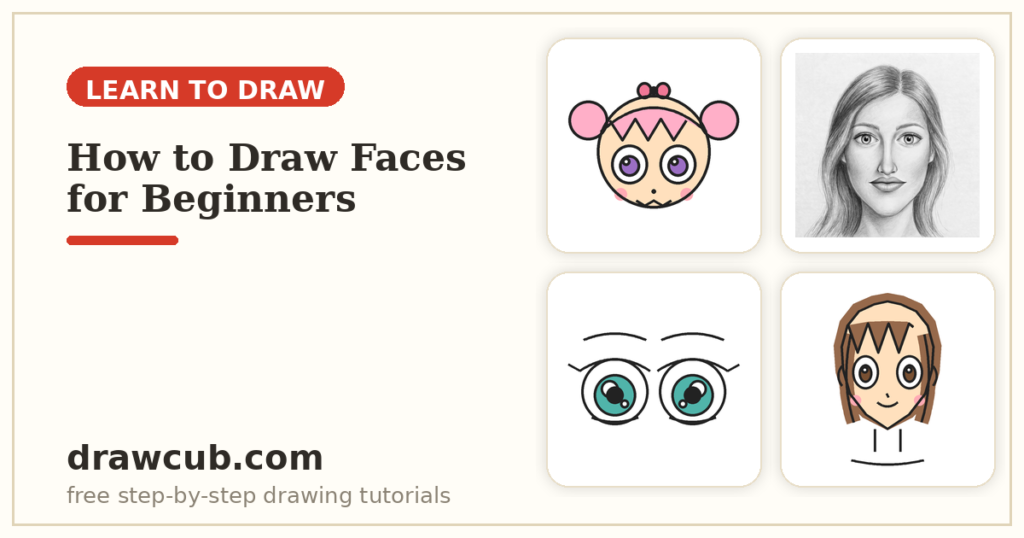
So here’s our plan: eight tutorials, in a sensible order, that take you from “I’m scared of faces” to “wait, that actually looks like a person.” Each takes about five minutes, one red line at a time, the DrawCub way.
Start Where Faces Are Forgiving
This is where we’d tell any beginner to start — us included. Chibi faces are the big-eyed, tiny-nosed cartoon style, and here’s why they’re perfect training wheels: the features are so simplified that nothing can go badly wrong. Two big eyes, a dot or a tiny line for a nose, a small mouth, done. You learn where everything sits on a face without the pressure of realism breathing down your neck. And they’re genuinely fun to draw — ours has a habit of looking cheerful no matter what you do.
The Real Thing (Sort Of)
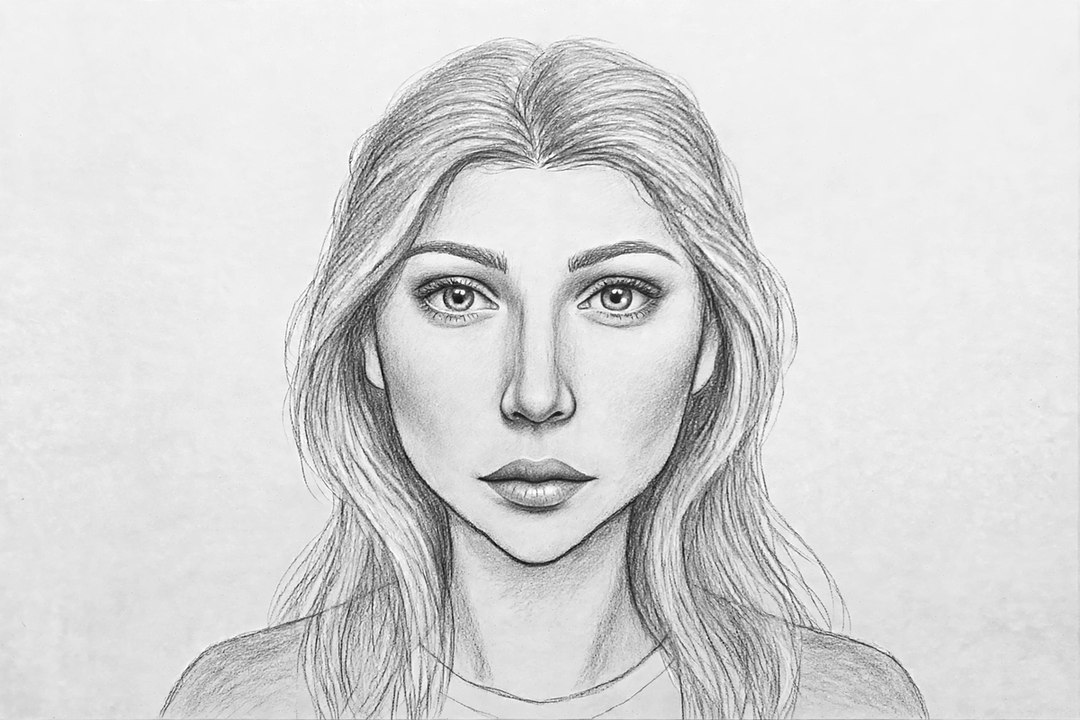
Okay. Deep breath. This is the one you were nervous about, and we get it — a proper front-facing human face. But here’s the thing nobody tells beginners: a front-facing face is mostly symmetry. Draw the oval, mark the lines, and then both halves mirror each other. Our tutorial walks you through the standard proportions (eyes at the halfway line — more on that later), and once you see the structure, the face stops feeling like guesswork. It won’t be portrait-perfect the first time. It doesn’t need to be. It needs to look like a person, and it will.
3. How to Draw a Face in Profile
Front views are one thing. Side views? That’s when faces get sneaky — the nose suddenly matters, the lips jut out, and the forehead-to-chin line has to be just right. But profiles are secretly easier than you’d think, because there’s only ONE eye to draw. Half the symmetry stress, gone. We’d honestly suggest a few profiles before committing to front views; they build confidence fast, and they make every sketchbook page look more advanced than it was to draw.
The Parts Department
Here’s our favorite trick for learning faces: stop drawing faces for a while and just draw parts. Fill a page with eyes. Then a page of noses. It’s like practising scales before playing a song — boring in theory, magic in practice. When you come back to a full face, your hand already knows what it’s doing.
Eyes are the part everyone obsesses over, and honestly? Fair. Eyes are where the expression lives. Anime eyes are a brilliant starting point — expressive but simple: big shapes, shiny highlights, no fussy realism. Once you can draw a confident anime eye, regular eyes are just a calmer version of the same idea. This tutorial is one of the most-used on the site, and after two practice pages you’ll understand why.
The nose has an unfair reputation. People treat it like the hardest part of the face, but it’s really just… a few lines. Seriously — most cartoon and beginner-style noses are a curve, a dot, maybe an angle. This tutorial strips the nose down to its essentials, and we’d bet this is the page where you go “oh, that’s ALL it is?” It happened to most of our team.
Lips trip people up for the opposite reason noses do: beginners draw them too heavily. A thick dark outline around the mouth makes every face look like it’s wearing stage makeup. The trick is soft lines and shading — and this tutorial shows you exactly how much (less than you think) and where (the corners and the middle shadow, mostly). Get this right and your faces jump from “cartoonish” to “hmm, actually pretty good.”
Put It All Together
7. How to Draw an Anime Girl Face
Now the payoff. You’ve got the chibi face down, you understand proportions, you’ve practised the parts separately — so this full anime girl face is where it all clicks. It’s a complete face, start to finish, with eyes, nose, mouth, and face shape in one tutorial. It’s also just a lovely drawing to have in your sketchbook. We’d colour this one in — big anime eyes look fantastic with a bit of marker or coloured pencil.
No face is finished without hair, and long hair is where a lot of beginners freeze. Strands! So many strands! But here’s the secret from this tutorial: you don’t draw strands, you draw sections. Big flowing shapes first, a few strand lines on top for detail. That order makes all the difference — it’s the same reason you draw a face’s oval before its eyes. Draw the hair on top of any face from the tutorials above and suddenly you’ve got a complete character. That’s not a bad outcome for one drawing session.
Tips That Actually Help
- The eyes sit at the halfway line. Not near the top — at the middle of the head. Almost every beginner draws eyes too high. Fold your paper lightly in half horizontally once; that crease is where the eyes go. It feels wrong the first time. It’s right.
- Draw the parts separately first. A page of just eyes, a page of just noses. It feels like a step backwards but it’s the fastest way forward — your hand learns the shapes without the pressure of a whole face.
- Use the mirror trick. Finished a face? Hold it up to a mirror (or flip your phone camera). The reversed image shows every lopsided line instantly. Artists have done this for centuries.
- Don’t outline lips darkly. Soft lines, light shading — the tutorial above shows how. A heavy lip outline ages every face by about forty years. You’re welcome.
- Draw big at first. Faces drawn small are much harder — the lines have nowhere to go. Use the whole page. You can go small once the shapes feel natural.
- Trace to learn, then freehand. Tracing a face you like isn’t cheating; it’s how you teach your hand the curves. Trace three, then try one on your own. You’ll feel the difference.
Your Turn
Pick the chibi face — seriously, start there — grab a pencil, and give yourself five minutes. Then grab our free Starter Pack at drawcub.com for printable practice pages to keep the streak going. And when you’re ready to sharpen the whole skill set, our 7 beginner tips that actually work is the perfect next read.
Faces stop being scary the moment you stop drawing them all at once. One part, one line, one five-minute tutorial. That’s the whole method — and it works.